Storing My Glue Bottle – No More Clogs!

Storing My Glue Bottle – No More Clogs!

I love the fine metal tips available for many of the glue bottles on the market today, but I hate that mine always seems to be clogged when I start a project even when a pin is used to seal the bottle when not in use. I even tried using an airtight glass jar in which to store it with no luck. (I use Art Institute Dries Clear Glue in a small refillable squeeze bottle.) I noticed that the glue bottle in the My Sweet Petunia Precision Glue Press is stored uncapped and upside down on a piece of silicone. I also saw Karen Burniston’s video (1:49) where she suggests to store glue bottles with the precision tips upside down in a jar with a damp paper towel on the bottom. The challenge with this (for me) is making sure the paper towel is always wet. But I used the 2 ideas which seems to have solved my clogging (and sealing) problem! My glue bottle now sits in a small glass cup with a piece of silicone on the bottom. It is always ready to use (not clogged), and I don’t have to stick a pin in it when I am not using it. Game changer!!

As long as the metal applicator is sitting directly on the silicone (and not at an angle), my glue is not oozing out and is always ready to go without clogging or waiting for the glue to flow to the tip.  I initially tried it in a small flower pot which was too wide for my small glue bottle causing the bottle to lean on an angle when placed inside.  Because the tip wasn’t completely resting on the silicone, I had leakage.  Then I tried a small paper cup, and while the bottle was upright, the cup was too light and tipped over. So the container needs to be close in size (across) to the glue bottle you are using and heavy enough that it doesn’t tip over when glue bottle is placed inside. I ended up using a small votive candle holder, and it was perfect for the glue bottle I was using. I used a circle die to trim a piece of silicone to fit flat on the bottom, but scissors would have worked also as the silicone is super easy to cut. If die cutting, I found it easiest to place the silicone between a folded scrap of copy paper before cutting as the silicone wanted to squeeze out from under the die. (I actually used 2 circles; not sure if that’s necessary!)

I may never have to clean a clogged tip or put a pin in my glue bottle again!!  Woohoo!!

Thanks for checking out my post!

This content uses referral links as described in the disclosure policy on my sidebar.

Standing Die and Stamp Storage

Standing Die and Stamp Storage

I am always amazed at how messy my desk becomes when I get going on a project and how often I’ve “lost” dies and stamps amongst the creative clutter! I created this stand-up storage tool on which to temporarily place the dies and stamps I need so I know where to find them while I work.

The black side is a magnet and can hold wafer thin dies (or other metal bits and bobs). The white side is a laminated surface and can hold clear or cling stamps. (You can also jot notes on it with a dry erase marker.)

It folds flat and fits in a regular A2 size envelope or card sleeve for storage. Because of this, I can keep it with my cutting plates and platform, and it is also great for travel when I craft away from home.

*

*

If you care to see how I made it, continue reading…

Continue reading

Technique Tags

Technique Tags

Technique Tags

(a blast from the past…)

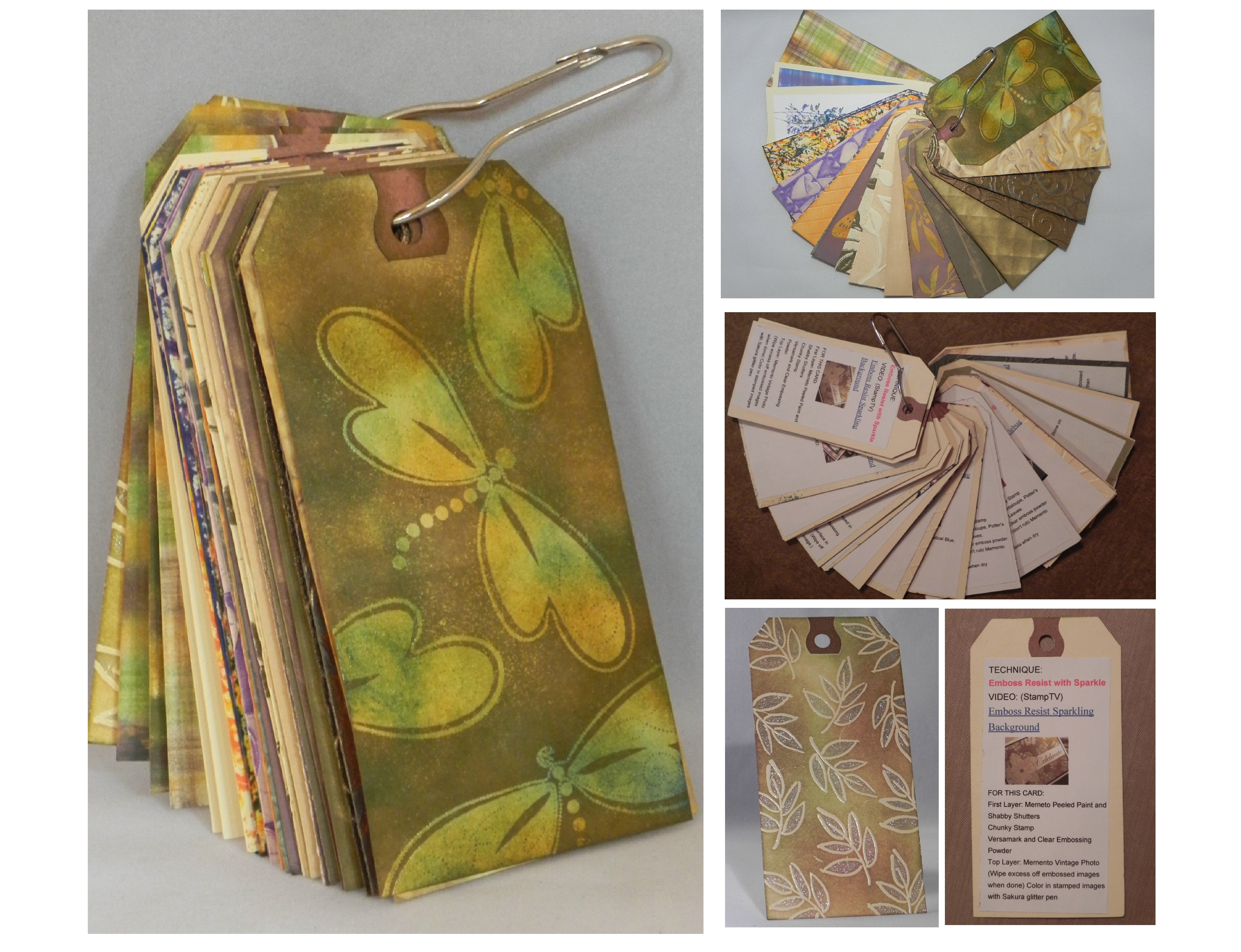
Here’s an idea that helps you keep track of new techniques you come across and also allows you to try them quickly without needing to create a whole, finished project…

Early in my card making “career,” I couldn’t get enough of the many technique videos and instructional posts available online.   I learned so much so quickly and couldn’t keep up with trying them all on complete card projects so I started doing technique samples on tags (with the video/instructional post location and instructions/notes on the backs).  I used a shower curtain ring to keep them together which made it easy to add new tags as I learned new techniques.  When I had time to work on a card project, I could flip through my tags to get ideas (and instructions) on techniques I had wanted to try.  (I still love watching technique videos, but I pace myself now – lol!)

Saving videos as “favorites” on YouTube or pinning cards and/or instructional blog posts to pinterest boards are also great ways to “remember” things you see and want to try, but the technique tags are a way to actually try the technique quickly without worrying about the rest of a card layout.

This project was originally shared on stamptv (June 14, 2013).  (Sadly, this site is no longer active, and the StampTV galleries no longer exist.)

Thanks for checking out my post!

How Should Ink Pads Be Stored?

How Should Ink Pads Be Stored?

question image

I recently received a question asking if dye ink pads should be stored upside down.  I have seen this question (and lots of opinions about it!) online and have often wondered what the answer is myself.

I sent an email to Tsukineko (Memento ink pads) asking this question and received no response.

I found this HERE on the Ranger site:   “How should I store my Distress Ink Pads?    The molded plastic case is designed to create the proper fit needed for the ink formulation. While storing the pads flat with the bottom side up will neither help nor hurt, we usually store pads on their sides or flat with the right side up.”

And HERE is an interesting video (at 4:21 mark) where Tim Holtz talks about how ink behaves in their pads and how they don’t need to be stored upside down.  (Thanks for pointing this out, Joyce!).  He talks about it again HERE (at 8:30 mark).

I also contacted customer service at Gina K Designs, and this is the response I received:  “It actually does not matter, it will not affect the quality of the ink at all. We store them with the colored label up here at our brick and mortar store. :)”

I am not an expert, but according to the sources I checked, it doesn’t really matter.  It seems to me (and this is just my opinion) that if the ink pads were supposed to be stored with the pads facing down, the manufacturers would put the ink pad on the lid. Since the pad is on the bottom and the label is on the top, it seems (to me) like that is the way they are to be stored (or at least that it is fine to store them this way).

Personally, I store my ink pads on their sides or with the lids facing up (because that is how my storage racks or containers hold them), and I have never had a problem.

When I am actually stamping, I usually place my stamp on the table facing up and tap the ink pad down on the stamp, and then I place the ink pad face down on its lid on my desk.  (I like to keep the lid on the pad when I am done inking the stamp, and this is just a more natural technique for me than flipping the pad over and picking up the lid.)  The ink pads are just as “inky” when stamping from this upside down position as when I first start using it from the upright position as it was stored.

Thanks for checking out my post!